
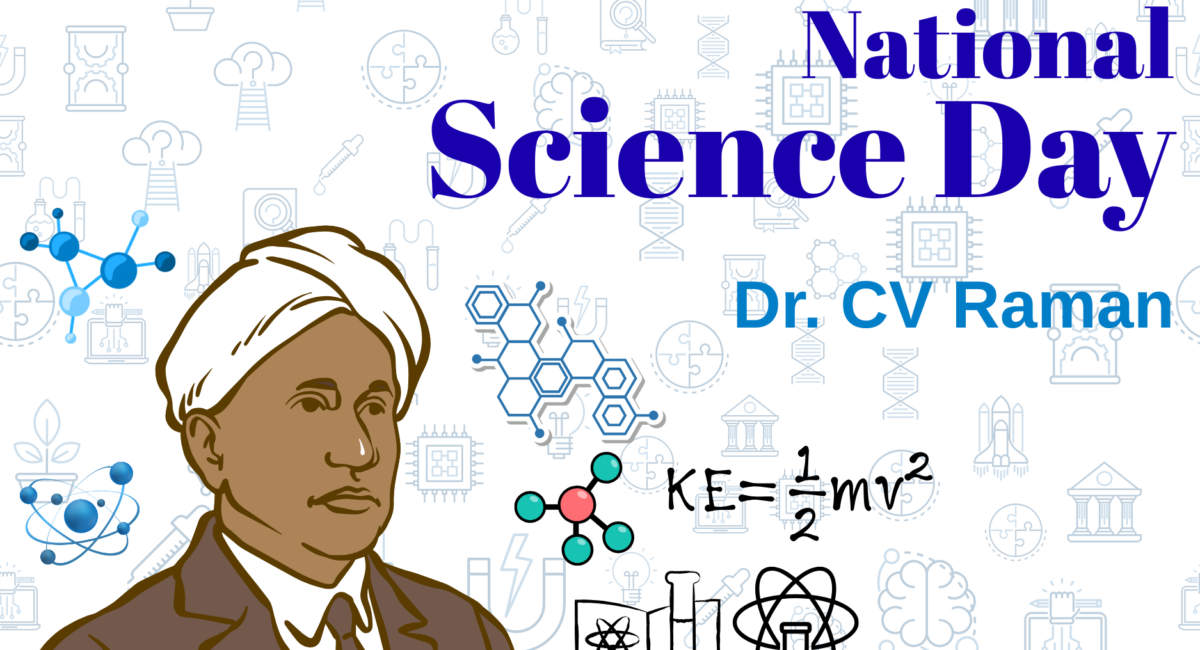
National Science Day
About Dr. CV Raman
C. V. Raman (Chandrasekhara Venkata Raman) was a famous Indian scientist and physicist, born on 7 November 1888 in Tiruchirappalli, Tamil Nadu. He is best known for discovering the Raman Effect, which explains how light changes when it passes through a transparent material.
For this discovery, C. V. Raman became the first Indian and first Asian scientist to receive the Nobel Prize in Physics (1930). His work greatly contributed to the field of spectroscopy and modern physics.
C. V. Raman was deeply interested in science from a young age and served as a professor at prestigious institutions. In his honor, 28 February is celebrated every year as National Science Day in India.
He passed away on 21 November 1970, but his contributions continue to inspire students and scientists across the world.
About National Science Day
National Science Day is celebrated every year on 28th February in India. This special day reminds us that science is not just about laboratories and textbooks—it is a part of our everyday life. From the alarm that wakes us up to the technology we use throughout the day, science quietly supports us at every step.
National Science Day marks the historic discovery of the Raman Effect by C. V. Raman on 28 February 1928. His discovery brought global recognition to Indian science and earned him the Nobel Prize in Physics in 1930. This achievement continues to inspire millions of students across the country.
The main aim of National Science Day is to encourage curiosity, creativity, and scientific thinking, especially among young minds. Schools, colleges, and institutions organize science exhibitions, experiments, seminars, and discussions where students learn not just facts, but how to ask questions and think logically.
This day also reminds us that science is meant to serve humanity. Whether it is healthcare, communication, education, or environmental protection, science helps improve the quality of our lives and build a better future.
National Science Day inspires us to believe that with curiosity and dedication, even a simple question can lead to a great discovery. After all, today’s curious learner could become tomorrow’s scientist.
Leave a Comment