
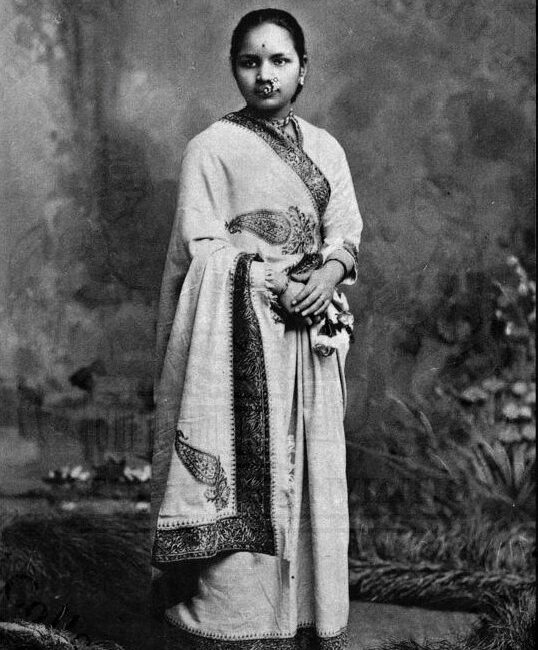
Memories of Anandi Gopal Joshi
Anandi Gopal Joshi — A Trailblazer in Indian History
In the mid-19th century, Indian society was bound by rigid traditions, especially around gender roles and education. In this context, the story of Anandi Gopal Joshi stands out not just as a biographical outline, but as a testament to courage, perseverance, and the radical pursuit of knowledge against overwhelming societal odds. Born at a time when girls rarely received schooling of any kind, Anandi’s life would become a milestone in the history of Indian women’s education.
Early Life and Childhood (1865–1874)
Anandi Joshi was born on 31 March 1865 in Kalyan, a small town in present-day Maharashtra, then part of the British Indian Bombay Presidency. Her birth name was Yamuna Joshi, a name she would later relinquish after marriage. She was born into a family that had once been landowners but had fallen on hard times due to financial pressure from high taxes and economic instability under colonial rule.
In those days, societal norms dictated that girls marry young — often long before adulthood. At the tender age of nine, Yamuna was married to Gopalrao Joshi, a widower much older than she was — nearly two decades her senior. This was unfortunately a common practice in conservative Indian communities at that time. Gopalrao, however, was no ordinary husband. Unlike many men of his era, he held progressive views on the education of women and insisted that his young wife be educated. It was this belief — radical for its time — that shaped the course of Anandi’s life.
Marriage and an Awakened Purpose
As Anandi grew older, her world began to change. Her husband taught her to read and write, starting with Marathi, then Sanskrit and English — languages that opened new worlds of knowledge to her. Though she was little more than a girl, these lessons planted the seeds of ambition and curiosity in her mind.
At the age of fourteen, tragedy struck. Anandi gave birth to her first child — a boy who lived only ten days. This devastating loss was not due to natural causes, but rather the absence of competent medical care — a harsh reality for women of that era, especially in conservative households where women were often denied access to outside doctors. This personal tragedy transformed her. Anandi realized that illness need not be fatal, that education in medicine could save lives, especially those of women who were unwilling or unable to consult male physicians because of cultural constraints.
This realization didn’t emerge quietly — it became her mission.
The Spark of Ambition: A Speech That Changed Everything
Gopalrao, recognizing his wife’s determination, went a step further. In 1880, he wrote to Royal Wilder, a well-known American missionary, expressing Anandi’s desire to study medicine in the United States — a country where women’s medical education was already established and where Indian women couldn’t yet study. Wilder published the letter, which drew attention in foreign circles.
Not everyone in Indian society supported their endeavor. There was vehement opposition from orthodox factions who felt women shouldn’t pursue higher education, and certainly not travel abroad alone. Religious conservatives warned against breaking social norms, and even some Christian missionaries encouraged Anandi only if she converted to Christianity first. Rather than shrinking from these pressures, she stepped up.
At Serampore College Hall, she delivered a powerful speech — not just a plea, but a declaration of purpose — explaining why India needed women doctors. She argued that many women would rather suffer than be treated by men, and that educated women physicians could provide needed care with dignity and cultural sensitivity. The speech galvanized support and helped raise funds for her trip overseas.
Journey to America: Challenges and Resolve
In June 1883, at the age of 19, Anandi set sail from Kolkata for New York. She was accompanied by female companions and missionaries who helped her adjust to life in a completely new cultural environment. Upon arrival in New York, she was received by Theodicia Carpenter, a New Jersey resident who became her mentor and supporter during her stay.
Anandi applied to the Woman’s Medical College of Pennsylvania, one of the very few institutions in the world — and the first in the United States — dedicated to training women as physicians. It was a bold leap: for an Indian woman to seek professional education in a foreign land, driven by a commitment to help her own people back home. A remarkable decision — especially in an era when societal expectations confined women to the hearth and home.
But America brought new challenges. The weather was cold, the food unfamiliar, and the rigorous course of study was demanding. Her health, already delicate, began to deteriorate. She experienced recurring fevers and weakness — later diagnosed as tuberculosis, a serious and often fatal disease at the time. Nonetheless, she persevered, determined to complete her studies.
Graduation and Recognition
On 11 March 1886, after years of unrelenting effort, Anandi completed her medical degree and earned her M.D. (Doctor of Medicine). Her thesis was titled “Obstetrics among the Aryan Hindoos” — a scholarly work blending traditional Indian medical understanding with Western scientific research. Her achievement was not just personal; it was symbolic — a bold assertion of women’s potential in science and medicine.
Her success drew international attention. Even Queen Victoria, then the Empress of India, sent a personal message of congratulations — an extraordinary recognition that highlighted the significance of her accomplishment.
Return to India and Legacy
Anandi returned to India in late 1886 to a hero’s welcome. Her achievements were celebrated as a matter of national pride by reformers, educators, and advocates of women’s rights. Recognizing her expertise, the princely state of Kolhapur appointed her as physician-in-charge of the female ward at Albert Edward Hospital — a remarkable appointment for a woman in that era.
But her triumph was bittersweet. The tuberculosis she had contracted in America worsened after her return. Just weeks before her 22nd birthday, on 26 February 1887, Anandi Gopal Joshi passed away in Pune. Her life, though tragically cut short, had already left an indelible mark on Indian society.
She was laid to rest in Poughkeepsie, New York, where her ashes were interred in the Poughkeepsie Rural Cemetery at Theodicia Carpenter’s request. This gesture symbolized the deep personal bonds she had built during her journey.
Why Anandi’s Story Matters
Anandi Gopal Joshi’s life embodied defiance of social convention and unwavering commitment to education and service. Long before widespread movements for women’s rights in India, she demonstrated that no ambition can be too large for a woman to pursue. Her achievements inspired other Indian women — like Kadambini Ganguly, who also became one of the first female Indian doctors in western medicine — to enter professions previously closed to them.
Her legacy has been honored in many ways: through biographies written in India and abroad, dramatic retellings on television and in film, and even by naming a crater on the planet Venus after her — a celestial tribute to her great spirit.
In Conclusion
Anandi Gopal Joshi’s life was short but extraordinary — a story of vision against adversity, of education overcoming tradition, and of courage transforming culture. She did not merely become the first Indian woman doctor; she became a symbol of aspiration and empowerment for generations of Indians, especially women, who followed in her footsteps. Her name remains etched in history not as a footnote, but as a beacon of possibility.