
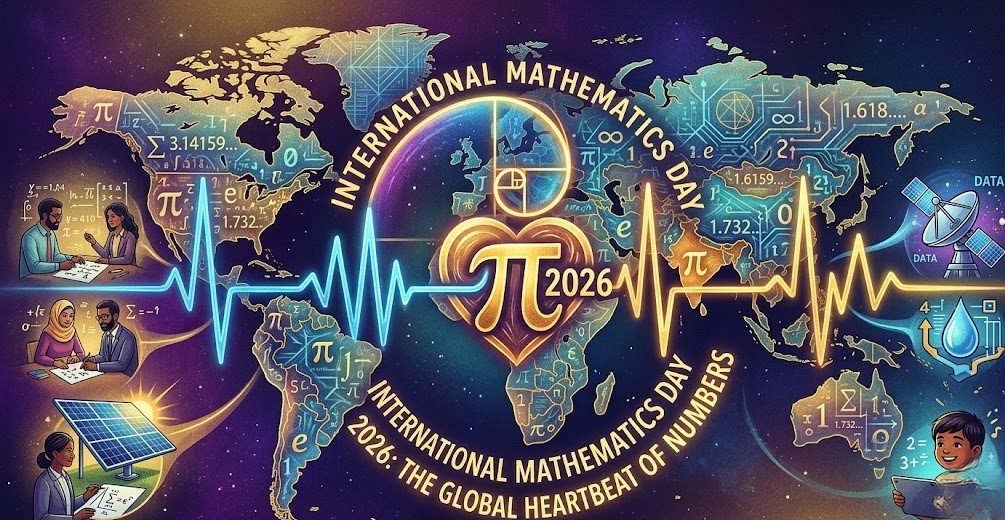
International Mathematics Day 2026: The Global Heartbeat of Numbers
Today, Saturday, March 14, 2026, is much more than just a date on the calendar. While many know it as “Pi Day,” since 2019, UNESCO has officially expanded this celebration to be the International Day of Mathematics (IDM).
This year’s theme is “Mathematics and Hope,” and it is a 100% original perspective on why we count, measure, and calculate.
The Unique History: A Tale of Circles and Pastries
The journey to today started thousands of years ago, but the “event” itself has a very human, quirky origin story:
- The Ancient Stalking of Pi: Around 250 B.C.E., the Greek genius Archimedes didn’t just guess the value of Pi; he “stalked” it. He drew a 96-sided shape inside and outside a circle to squeeze the truth out of the number. He found it was roughly 3.14, a discovery that stood the test of time for centuries.
- The “Prince of Pi” (1988): Fast forward to San Francisco. A physicist named Larry Shaw (the “Prince of Pi”) decided that math was too serious and needed a party. He organized a parade where people walked in circles and ate fruit pies. This “humanized” math, taking it out of the dusty textbooks and into the kitchen!
- The Global Upgrade (2019): UNESCO realized that the world’s challenges—like climate change and health—needed a universal language. They officially proclaimed March 14 as IDM to celebrate math as a tool for the common good.
2026 Theme: “Mathematics and Hope”
This year is special. In a world full of complex data and uncertainty, math is being celebrated as a resource for hope.
- Clarity in Chaos: Math helps us predict weather, track health, and build bridges—literally and figuratively.
- Universal Language: No matter what language you speak, 2+2 is always 4. It’s the one thing that connects every human on the planet.
- India’s Legacy: While the world celebrates today, we also carry the spirit of Srinivasa Ramanujan, who saw “patterns in the infinite” and proved that mathematical hope can come from anywhere, even a small porch in Kumbakonam.
1. The Dawn of Counting: Finding Order (35,000 BCE)
The journey didn’t start in a classroom; it started on a bone. The Ishango Bone, found in Africa, shows tally marks that suggest early humans were already tracking lunar cycles or simple tallies.
- The Human Touch: We didn’t count because we wanted to pass a test; we counted because we wanted to know when the moon would be full or when the seasons would change.
2. The Shape of the World: Geometry (2000 BCE – 300 BCE)
The Babylonians and Egyptians needed to measure land after the Nile flooded. This led to the birth of Geometry (literally “Earth-Measurement”).
- The Greek Leap: Thales and Pythagoras began to prove why things were true. Then came Euclid, who wrote The Elements, the most successful textbook in history.
3. The Magic of Nothing: The Indian Revolution (5th Century CE)
This is one of the most original and vital parts of the journey. Indian mathematicians like Aryabhata and Brahmagupta gave the world Zero ($0$).
- The Impact: Without zero as a placeholder and a number, modern calculus, computers, and the phone you are using right now would be impossible. It was the ultimate “humanized” invention—giving a name to “nothingness.”
4. The Language of Change: Calculus (17th Century)
As we started looking at the stars and falling apples, we needed math that could handle movement. Newton and Leibniz independently “discovered” Calculus.
- The Tool: It allowed us to calculate the slope of a curve at any single point.
5. The Modern Era: Patterns & Hope (20th Century – 2026)
We moved into Abstraction. Great minds like Srinivasa Ramanujan saw patterns in infinite series that no one else could see. Today, math is the “invisible engine” behind: