
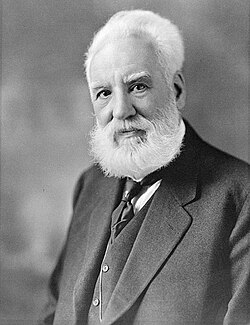
Alexander Graham Bell Day
Alexander Graham Bell – Inventor of the Telephone
Alexander Graham Bell was one of the most influential inventors in modern history. He is best known for inventing the telephone, a device that changed the way people communicate around the world. Before the telephone, communication over long distances was slow and depended mainly on letters or telegraph messages. Bell’s invention allowed people to speak to each other instantly across great distances. His work in science, communication, and education made a lasting impact on society. Bell was not only an inventor but also a teacher, scientist, and innovator who devoted much of his life to improving communication, especially for people who were deaf.
Early Life and Childhood
Alexander Graham Bell was born on March 3, 1847, in Edinburgh, Scotland. He grew up in a family that was deeply interested in speech and communication. His father, Alexander Melville Bell, was a professor who studied speech and developed a system called “Visible Speech,” which helped people learn how to pronounce words correctly. Bell’s mother, Eliza Grace Symonds Bell, was partially deaf, and this greatly influenced his life.
As a young boy, Bell showed great curiosity and creativity. He enjoyed experimenting and building things. One of his first inventions was a simple machine that could remove the husks from wheat. Even as a child, he demonstrated a strong interest in science and sound. His mother’s hearing problem motivated him to study how sound works and how people communicate.
Education and Interest in Sound
Bell attended school in Scotland and later studied at the University of Edinburgh and the University College London. Although he was intelligent, Bell preferred experimenting and exploring ideas rather than traditional classroom learning. He became very interested in acoustics, the science of sound.
In 1870, Bell and his family moved to Canada after the deaths of his two brothers from tuberculosis. A year later, he moved to Boston in the United States, where he began teaching deaf students. His work with the deaf community became a very important part of his life.
Work with Deaf Students
Bell believed that people who were deaf should have the opportunity to communicate effectively with others. In Boston, he worked as a teacher at the Boston School for Deaf Mutes. He later became a professor at Boston University, where he taught vocal physiology and speech.
One of Bell’s most famous students was Helen Keller, who later became a well-known author and activist. Bell helped Keller and her family find proper education and support.
His work with deaf students helped him understand the nature of sound and speech more deeply. This knowledge played a major role in his later inventions.
The Invention of the Telephone
Bell’s greatest achievement was the invention of the telephone. During the 1870s, scientists were trying to improve the telegraph, which could only send coded messages. Bell wanted to create a device that could send the human voice over electrical wires.
While working with his assistant, Thomas Watson, Bell conducted many experiments. Finally, on March 7, 1876, he received a patent for the telephone. Just three days later, he made the first successful telephone call.
Bell spoke the famous words:
“Mr. Watson, come here, I want to see you.”
Watson, who was in another room, heard Bell’s voice through the telephone device and came immediately. This moment marked the beginning of a new era in communication.
Bell’s invention quickly gained attention and interest. Soon, telephone systems began spreading across cities and countries.
The Bell Telephone Company
In 1877, Bell and his partners established the Bell Telephone Company to develop and distribute the new technology. The company helped build telephone networks and install telephones in homes and businesses.
The telephone quickly became popular because it made communication faster and easier. Over time, Bell’s company grew and eventually became part of what is now known as AT&T, one of the largest telecommunications companies in the world.
Other Inventions and Scientific Work
Although Bell is famous for the telephone, he also worked on many other inventions and scientific ideas. He was fascinated by flight and experimented with early flying machines. He also worked on devices related to sound recording and communication.
One of his inventions was the photophone, a device that could transmit sound using light waves. Although it was not widely used at the time, the idea later became important in modern fiber-optic communication.
Bell also helped develop early metal detectors. In 1881, he used one of his devices in an attempt to locate a bullet in the body of James A. Garfield, the President of the United States who had been shot.
Personal Life
Bell married Mabel Gardiner Hubbard in 1877. Mabel was deaf from childhood, which further strengthened Bell’s commitment to helping people with hearing disabilities.
The couple had four children and lived a comfortable life due to Bell’s success. They spent much of their time in Washington, D.C. and also at their estate in Beinn Bhreagh.
Bell continued his experiments and research throughout his life, exploring topics such as aeronautics, marine engineering, and communication technology.
Later Years and Achievements
Bell received many honors and awards during his lifetime. Scientists and institutions around the world recognized his contributions to science and technology. He was also involved with the National Geographic Society and served as its president. During his leadership, the society improved its magazine and expanded its scientific work.
Bell remained active in research until his final years. He believed strongly in innovation and education. His curiosity and determination continued to inspire young scientists.
Death and Legacy
Alexander Graham Bell died on August 2, 1922, at the age of 75 in Beinn Bhreagh. As a tribute to him, telephone services across the United States and Canada were briefly stopped during his funeral.
Bell’s invention of the telephone transformed the world. Today, billions of people use telephones and mobile devices to communicate instantly across the globe. Modern smartphones, internet calls, and video communication all trace their origins back to Bell’s original invention.
Conclusion
Alexander Graham Bell was more than just the inventor of the telephone. He was a visionary scientist who believed in the power of communication to connect people. His work with deaf individuals showed his compassion and dedication to improving human lives.
Bell’s curiosity, creativity, and determination led to one of the greatest inventions in human history. The telephone revolutionized communication and laid the foundation for modern telecommunications. Even today, his contributions continue to influence technology and society.
Through his inventions and ideas, Alexander Graham Bell changed the world forever. His life remains an inspiring example of how innovation and determination can create progress that benefits all of humanity.