
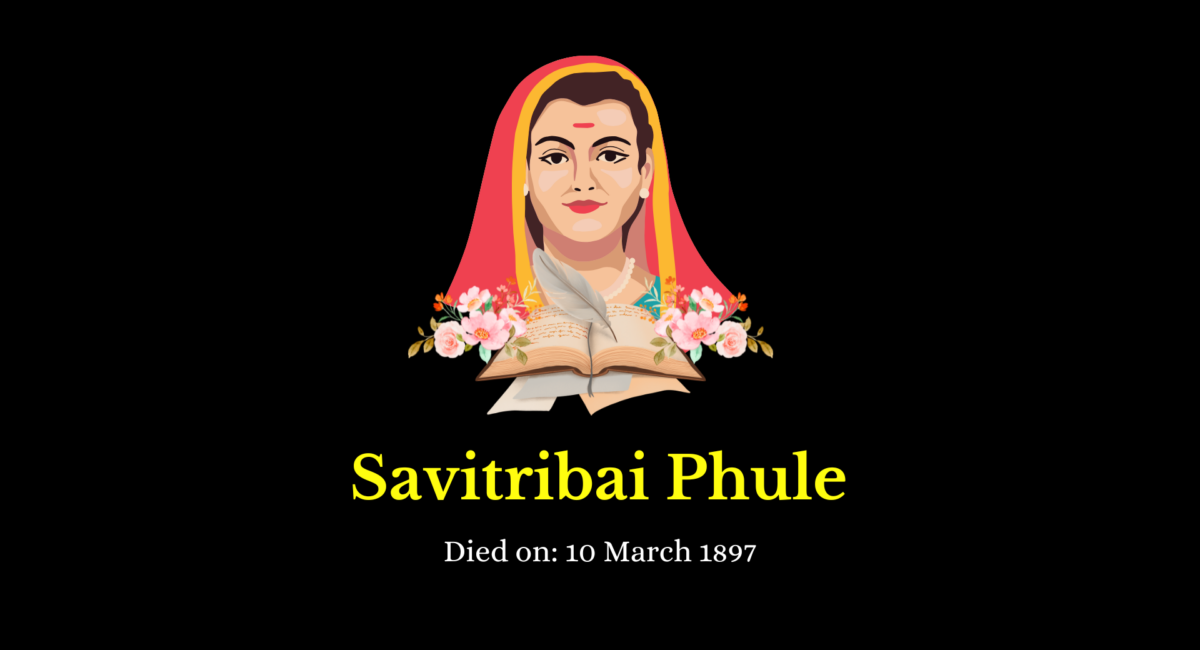
Memories of Savitribai Phule
Savitribai Phule was one of the greatest social reformers, educators, and women’s rights activists in India. She is widely known as the first female teacher of India and a pioneer of women’s education and social equality. During a time when girls were not allowed to study and society was dominated by strict caste discrimination, Savitribai courageously worked to bring education and dignity to women, lower-caste communities, and oppressed people.
Her life was a powerful example of determination, compassion, and social reform. From her humble birth to her heroic death while serving plague victims, Savitribai Phule dedicated her entire life to helping others and fighting injustice.
Birth and Early Life
Savitribai Phule was born on 3 January 1831 in the village of Naigaon, located in the present-day state of Maharashtra, India. Her father’s name was Khandoji Nevase Patil, and her mother’s name was Lakshmi Bai Nevase. They belonged to a farming family and lived a simple rural life.
In the 19th century, Indian society had many strict traditions. Girls were usually not allowed to go to school, and child marriage was very common. Because of these social customs, Savitribai did not receive formal education during her childhood.
However, she was intelligent, curious, and eager to learn. Her life changed after her marriage, which opened the door for her education and later her social reform work.
Marriage and Beginning of Education
Savitribai was married at the age of nine to Jyotirao Phule, who later became one of the greatest social reformers in India. At that time, Jyotirao was about 13 years old.
Unlike most men of that period, Jyotirao strongly believed that women should be educated. After their marriage, he began teaching Savitribai how to read and write at home. With great dedication and interest, Savitribai quickly learned and developed a strong passion for education.
Later, she received further teacher training with the support of Jyotirao and their friend Fatima Sheikh, who also became one of India’s first Muslim women teachers.
Savitribai’s education was a revolutionary step because society at that time strongly opposed women studying or teaching.
Starting the First Girls’ School in India
In 1848, Savitribai Phule and Jyotirao Phule started the first school for girls in India in Pune, Maharashtra.
Savitribai became the first woman teacher of India and began teaching young girls from different communities. This was a historic moment in Indian education because girls had rarely been given the opportunity to study.
Soon after, Savitribai and Jyotirao opened several more schools for girls and children from marginalized communities. Their schools focused on subjects like:
Mathematics
Science
Social studies
Reading and writing
At one time, they were running more than 18 schools, which was a remarkable achievement during that era.
Social Opposition and Struggles
Savitribai Phule faced severe opposition from society for educating girls and lower-caste children. Many people believed that women should only stay at home and not receive education.
When Savitribai walked to school every day, some people insulted her, threw stones, mud, and cow dung at her to stop her work. But she remained strong and determined.
To handle these attacks, Savitribai carried an extra saree with her. When people threw dirt on her clothes, she would change into the clean saree and continue teaching.
Her courage and determination became an inspiration for many people who later joined the movement for women’s education.
Work for Women’s Rights
Savitribai Phule did not only focus on education; she also worked for women’s rights and social justice.
During that period, widows in society faced extreme discrimination. Many widows were forced to shave their heads and live isolated lives. In some tragic cases, widows who became pregnant were pressured into killing their babies due to social stigma.
To help these women, Savitribai and Jyotirao started a shelter called Balhatya Pratibandhak Griha, which protected pregnant widows and allowed them to safely give birth and raise their children.
They also worked against harmful practices such as:
Child marriage
Untouchability
Caste discrimination
Widow oppression
Savitribai strongly believed that education was the key to social equality and empowerment.
Literary Contributions
Savitribai Phule was also a talented poet and writer. Through her poems and writings, she encouraged people to pursue education and fight against injustice.
Some of her famous works include:
Kavya Phule (1854)
Bavan Kashi Subodh Ratnakar (1892)
Her poetry often talked about:
The importance of education
Freedom from social oppression
Equality for women and lower castes
Her writings continue to inspire students, activists, and scholars even today.
Work After Jyotirao Phule’s Death
In 1890, Savitribai’s husband Jyotirao Phule passed away.
After his death, Savitribai continued his mission with great courage. She became a leader of the Satyashodhak Samaj, an organization founded by Jyotirao to promote equality and social justice.
She continued spreading education and awareness across different communities and worked tirelessly for social reform.
Service During the Plague Epidemic
In 1897, a deadly outbreak of Bubonic Plague spread in Pune and nearby areas.
Savitribai Phule and her adopted son Yashwantrao Phule, who was a doctor, started a clinic to help plague patients. They worked day and night to care for the sick and provide medical help.
One day, Savitribai found a sick child suffering from the plague on the roadside. She carried the child on her back and took him to the hospital for treatment.
Unfortunately, during this act of kindness, she became infected with the disease.
Death
Savitribai Phule passed away on 10 March 1897 due to the plague infection she contracted while helping others.
Her death was truly heroic, as she sacrificed her life while serving people in need.
Legacy and Contribution
Savitribai Phule’s work changed the course of Indian society. She is remembered as:
India’s first female teacher
A pioneer of women’s education
A champion of social equality
A courageous social reformer
Today, many schools, universities, and institutions are named in her honor, including Savitribai Phule Pune University in Pune.
Her birth anniversary on 3 January is celebrated across India as Balika Din (Girl Child Day) in Maharashtra to honor her contribution to girls’ education.
Conclusion
The life of Savitribai Phule is a powerful story of courage, dedication, and social change. At a time when women had very few rights, she stood against injustice and worked tirelessly to bring education and equality to society.
Despite facing insults, threats, and hardships, she never gave up her mission. Her efforts opened the doors of education for millions of girls and helped build a more equal and progressive India.
Savitribai Phule’s legacy continues to inspire generations to fight for education, equality, and human dignity. Her life proves that one determined person can truly change the world. 🌼📚